
TAIPEI, Taiwan — May 23, 2020 — Much of Taiwan’s industry is being transformed by the introduction of AI technologies, particularly in the areas of manufacturing and healthcare.
Industry the world over is experiencing some radical changes, propelled by the continued development and application of AI technology across a wide variety of different fields. While in most countries everything from finance and banking to transportation and logistics is being revolutionized by AI, certain areas in Taiwan are undergoing more drastic transformations than others due to the country’s natural advantages in those sectors. These fields include robotics for industrial automation, semiconductor and hardware manufacturing, as well as for healthcare.
In these areas, as well as many others, Taiwan stands to reap the most benefits by integrating innovative software capabilities into its existing hardware infrastructure.
Taiwan’s economic miracle began with its shift to export-oriented manufacturing in the 1970s, and manufacturing is still a core driver of Taiwan’s economy today. Furthermore, an increasing number of Taiwanese manufacturers have begun leaning toward industrial automation, boosting demand for smart machinery – including intelligent robots – in production lines. Both government and industry have seized this opportunity to promote the development of AI-enabled manufacturing capabilities in Taiwan.
The Ministry of Science and Technology (MOST) in 2018 launched the NT$2 billion (US$66.59 million) Robot Makerspace initiative, which established smart robotics hubs in Taichung and Tainan within the Central and Southern Taiwan Science Parks. These centers offer co-working spaces and accelerators for startups to test their solutions.
According to MOST Deputy Minister Hsu Yu-Chin, the central and southern robotics hubs had hosted 71 startups as of the end of last year – 43 of them local or international AI-related startups from the ministry’s Taiwan Tech Arena program. Startups at the two hubs have been responsible for more than 99 new products or technologies, and in 2019 generated over US$400 million in overseas venture capital and international business collaboration opportunities.
Other industrial automation projects are being carried out by the government-backed Industrial Technology Research Institute (ITRI), including a self-taught robot technology that utilizes deep reinforcement learning algorithms. Vincent Feng, general director of the Computational Intelligence Technology Center at ITRI, notes that the robotics currently used in manufacturing are semi-automatic and do not have AI capabilities. However, since production in Industry 4.0 can vary from time to time, Feng says, robots should be able to learn to recognize the shape of different objects and materials.
Solomon Advances AI Vision for Smart Manufacturing
Originally specializing in power generation and electrical components, Taiwanese tech company Solomon has in recent years begun developing computer vision and AI systems for industrial automation.
AI is not solely the province of startups and large tech multinationals. A growing number of Taiwan’s more established technology companies are beginning to explore AI-enabled robotics solutions for their client base as well.
Founded in 1973, Solomon Technology Corp. has expanded its scope of business over the years, going from the initial distribution of power generators and electrical components to the addition of LCDs, semiconductors, and batteries in the 1980s and 1990s. In 2009 the company became a distributor for Rockwell Automation, the world’s largest industrial automation company. It was at that time, says Solomon Chairman Johnny Chen, that the company began to get interested in what it could do with robots.
“I was going to a lot of trade shows, and all of the robots I saw were just doing repetitive tasks,” says Chen. “We started looking into vision systems and figured that this would be key to solving a lot of the more complex problems you find in production lines.”
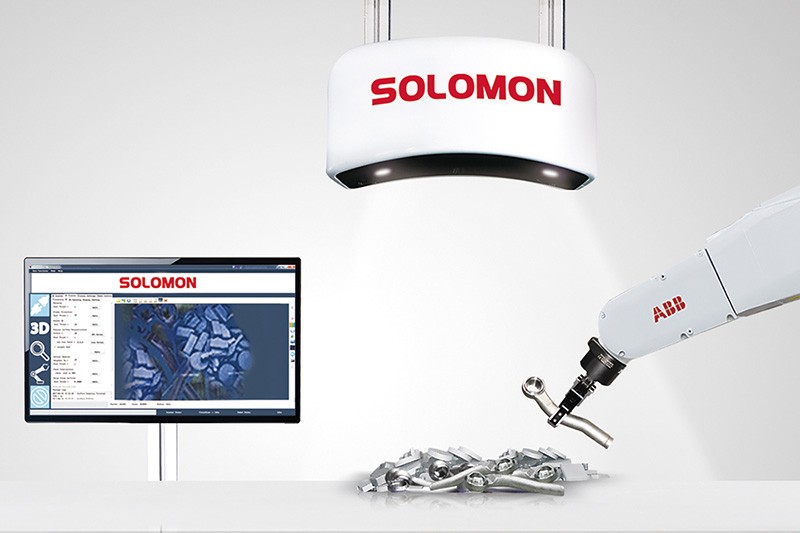
The company began building up an R&D team to develop its own 3D computer vision system – a robot’s “eyes,” as Chen puts it. The machine vision is combined with AI deep learning technology to give the robots the added benefit of a “brain” – the ability to recognize complex objects and patterns.
According to Chen, Solomon’s decision to delve into AI and machine vision has really begun to pay off. Its systems are now being applied by some of the world’s leading automobile, consumer goods, and e-commerce companies. Solomon’s 3D vision design has received international recognition as well, winning the prestigious Vision System Design Innovators Award in Chicago last year.
This article was originally published in Taiwan Business Topics on May 23, 2020