
What Is Physical AI? A Guide to Industrial Applications
What Is Physical AI?
Physical AI is artificial intelligence embedded in machines that can sense their environment, interpret conditions, and perform physical actions in real time. In industrial settings, it is used in robotics, inspection systems, autonomous vehicles, and production equipment operating in dynamic environments.
Unlike software-only AI systems, Physical AI directly interacts with the physical world through sensors, control systems, and actuators, enabling closed-loop decision-making between perception and action.
Why Physical AI Is Gaining Attention
Artificial intelligence has already improved forecasting, scheduling, and analytics. However, many industrial bottlenecks are not digital problems. They occur on factory floors, warehouse aisles, and production lines where machines must interact with real materials, motion, and variability.
Physical AI addresses this gap by enabling machines to operate in real-world environments rather than only generating software-based outputs.
Typical capabilities include:
- inspecting products inline
- identifying and picking mixed or randomly oriented objects
- navigating dynamic environments
- adapting to changing part positions
- supporting human workers in shared workspaces
This shift is already visible at scale. According to the International Federation of Robotics (IFR) World Robotics 2025 report, more than 4 million industrial robots are now in operation worldwide. This reflects sustained investment in automation and a continued transition toward more intelligent and adaptive production systems.
This growth highlights a broader industrial shift toward systems capable of handling variability in materials, environments, and workflows across manufacturing and logistics operations.
For manufacturers and other industrial end users, the opportunity is practical: applying AI to improve throughput, quality, flexibility, and labor efficiency.
How Physical AI Differs From Traditional AI
Traditional AI
Traditional AI typically operates in digital environments and produces analytical outputs.
Common applications include:
- production forecasting
- predictive maintenance analytics
- scheduling optimization
- quality trend reporting
- conversational interfaces
Its output is information, prediction, or recommendation.
Physical AI
Physical AI operates within machines interacting directly with physical environments.
Examples include:
- robots adjusting grip based on object detection
- inspection systems rejecting defective products inline
- AMRs rerouting around obstacles in real time
- humanoid robots assisting in structured environments
- picking systems identifying and handling unstructured objects
Its output is physical action, not just insight.
In practice, Physical AI systems are typically implemented as hybrid architectures combining traditional control systems (PLC-based logic and motion control) with AI-driven perception and decision modules.
Simple Rule of Thumb
If AI changes what a machine does in the physical world—not just what a system reports—it is Physical AI.
Core Industrial Applications of Physical AI
AI Inspection Systems
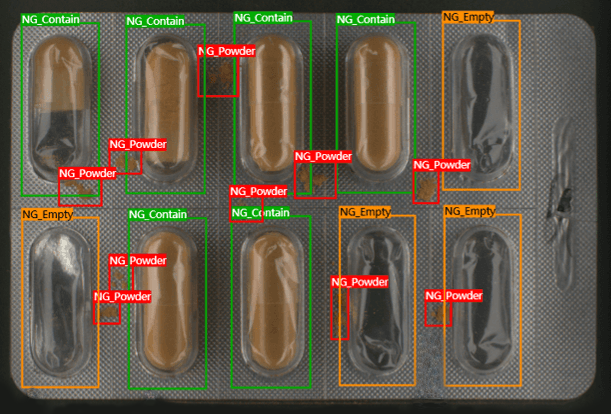
One of the most established industrial uses of Physical AI is machine vision inspection.
Used for:
- surface defects
- cosmetic inconsistencies
- missing components
- label verification
- assembly validation
These AI visual inspection systems are particularly effective in environments where defect variation makes rule-based inspection unreliable.
Robotic Picking and Material Handling
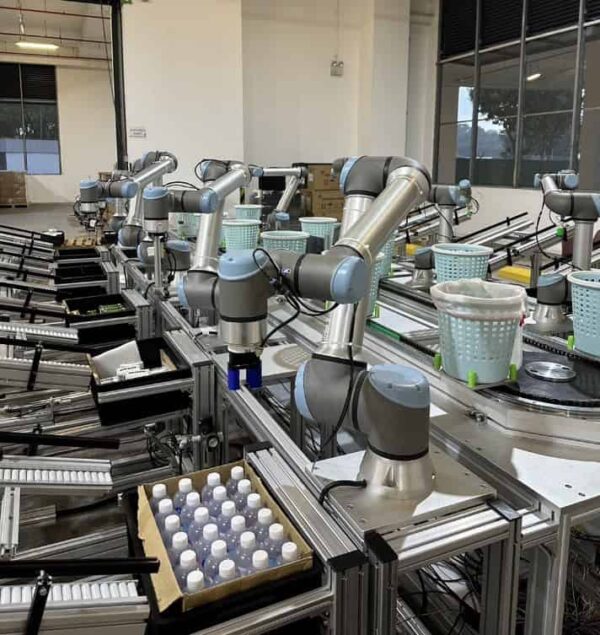
Physical AI is widely used in environments where object position, orientation, or geometry is inconsistent. This is a core capability in AI robotic picking solutions, where systems must interpret and adapt to unstructured objects in real time.
Applications include:
- bin picking
- depalletizing
- mixed-case palletizing
- order fulfillment picking
These tasks require perception-driven adaptation rather than fixed coordinate execution.
Autonomous Internal Transport
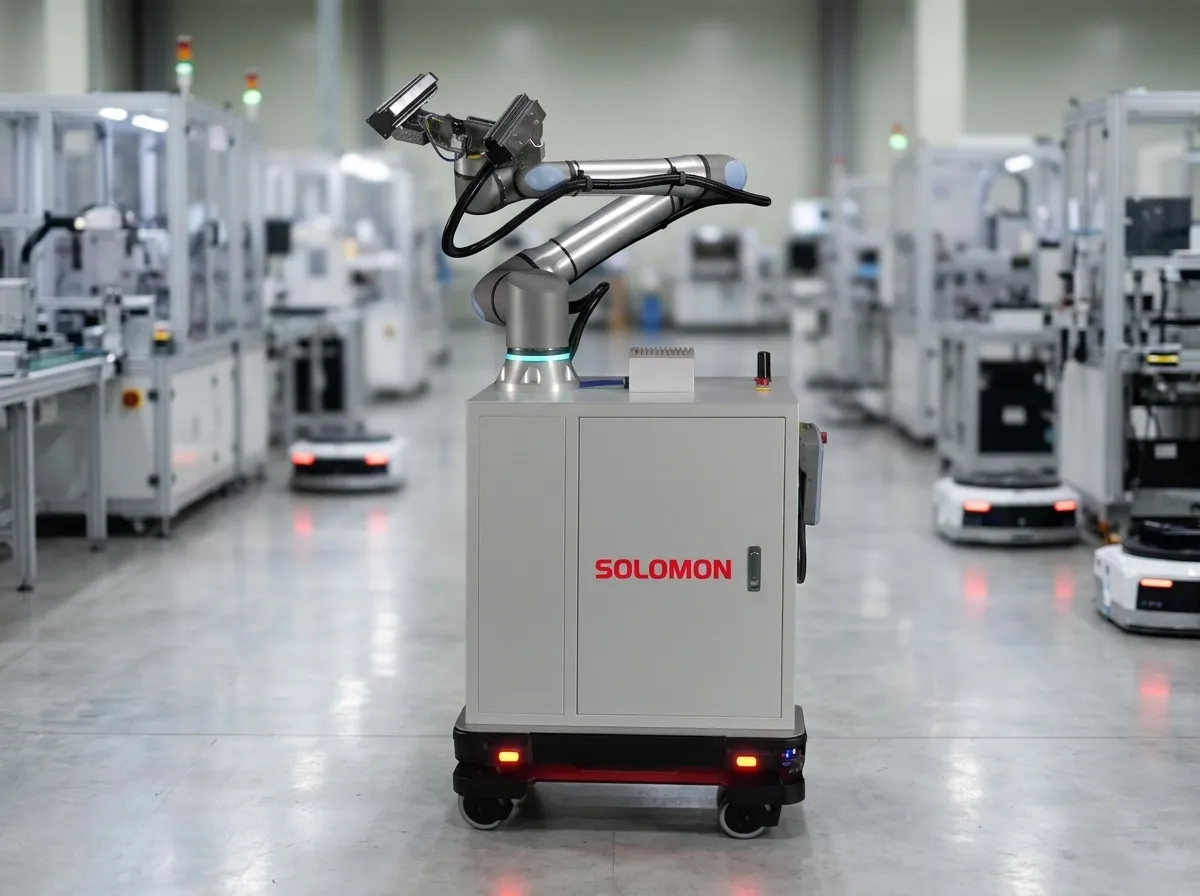
Factories and warehouses use AI-enabled mobile systems for internal logistics movement.
Examples include:
- autonomous mobile robots (AMRs)
- dynamic route material delivery
- point-to-point transport between stations
- warehouse replenishment flows
These systems rely on real-time perception and navigation rather than fixed-path infrastructure.
Emerging Robotics and Humanoid Systems
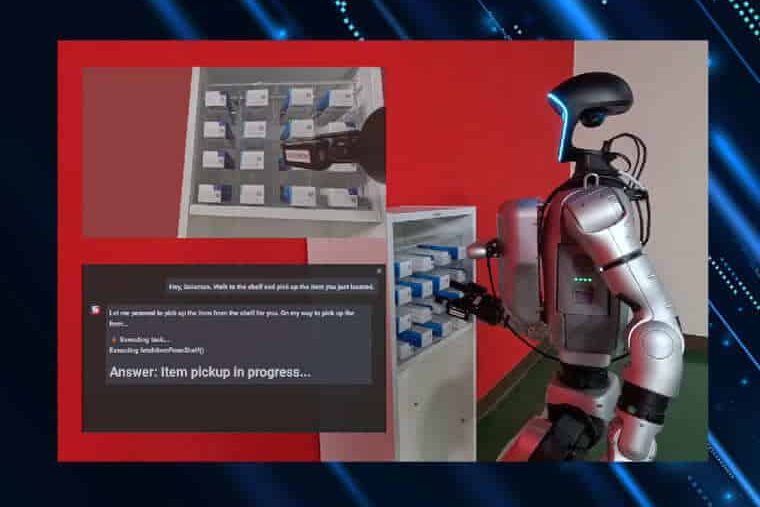
Physical AI is also enabling more advanced robotic systems designed for human-centric environments, including emerging humanoid platforms.
Potential applications include:
- repetitive material movement
- shared workspace assistance
- inspection rounds
- tool and component delivery
- flexible operational support
As mobility, dexterity, and reasoning capabilities improve, these systems are expected to expand the scope of industrial automation.
Where Physical AI Delivers Value
Physical AI delivers the most value when operations involve variability, manual intervention, or performance constraints that are difficult to stabilize with fixed automation.
These conditions typically include:
High Variability
- changing SKUs
- inconsistent part orientation
- variable packaging conditions
- fluctuating defect patterns
Manual Intervention Loops
- repetitive visual inspection
- robot re-teaching cycles
- operator-assisted sorting
- exception handling in workflows
Measurable Operational Constraints
- throughput limitations
- scrap and rework rates
- labor shortages
- changeover inefficiencies
- inconsistent quality outcomes
In these environments, Physical AI improves stability, adaptability, and overall operational efficiency by enabling machines to respond to real-world variation in real time.
Physical AI Deployment Considerations
Successful Physical AI deployment depends on integration with real production conditions, not just model accuracy.
Data Readiness
Physical AI systems rely on representative real-world data that captures:
- variation in part appearance and orientation
- edge cases such as occlusion, glare, and deformation
- production line inconsistencies over time
Insufficient or poorly aligned synthetic or real-world data can reduce performance in live environments if not properly balanced with domain adaptation techniques.
System Integration
Physical AI must operate within existing industrial control and execution layers, including:
- PLC systems for machine-level control
- MES platforms for production coordination
- robotic controllers for motion execution
- existing inspection or handling workflows
Integration complexity is often a key determinant of deployment success.
Environmental Variability
Industrial environments introduce continuous physical variation, including:
- lighting changes across shifts
- vibration from surrounding machinery
- dust, reflection, and surface contamination
- layout or fixture adjustments over time
These factors directly affect perception accuracy and must be accounted for during system design and calibration.
How to Deploy Physical AI
Most successful Physical AI deployments begin with a clearly defined operational challenge rather than broad transformation programs.
Common starting points include:
- inspection bottlenecks
- complex picking tasks
- recurring quality escapes
- repetitive manual processes
- variable workflows resistant to fixed automation
A structured proof of concept (POC) is typically used to validate feasibility in real production conditions before scaling.
A well-scoped POC can help assess:
- technical performance in live environments
- accuracy and reliability
- integration with existing systems
- operational ROI potential
- scalability across lines or facilities
This approach reduces deployment risk while building a clear foundation for production rollout.
Conclusion
Physical AI is artificial intelligence that enables machines to sense, decide, and act in the physical world.
In industrial environments, it is already delivering value across inspection systems, robotic picking, autonomous transport, adaptive equipment control, and emerging robotics applications.
For manufacturers and industrial operators, the key question is not whether Physical AI is relevant—but where intelligent automation can create measurable operational improvements.
That is where the next generation of industrial efficiency gains will emerge.
Physical AI FAQs
What is Physical AI in simple terms?
Physical AI is AI used in machines that can perceive real-world conditions and perform physical actions such as moving, inspecting, sorting, or navigating.
Is Physical AI the same as robotics?
No. Robotics is one application area. Physical AI also includes inspection systems, autonomous vehicles, intelligent machines, and emerging humanoid systems.
Where is Physical AI used in manufacturing?
It is commonly used in quality inspection, robotic picking, material handling, autonomous transport, and adaptive machine control.
Why is Physical AI important?
It enables automation in environments with variability, movement, and real-time decision requirements that traditional systems struggle to handle.