
Automated Visual Inspection: 5 Key Benefits for Quality Control (QC)
Manual inspection has long been a core part of manufacturing quality control (QC), but it introduces inherent limitations in consistency, scalability, and speed. As production volumes increase and tolerances become tighter, these constraints can directly impact yield, efficiency, and operational stability.
Automated visual inspection uses AI and machine vision to support quality control by detecting defects in real time with consistent, repeatable accuracy. It replaces subjective manual inspection with standardized, data-driven evaluation directly on the production line.
Key benefits include improved inspection consistency, faster throughput, enhanced traceability, scalable operations, and more data-driven quality control.
Across industries, especially in manufacturing, automotive, electronics, and food production, automated visual inspection is increasingly adopted to support consistent QC processes and improve traceability.
1. Reducing Subjectivity in Quality Control
Manual QC is influenced by human factors such as fatigue, experience level, and environmental conditions. Industrial research on visual inspection tasks has reported accuracy levels of around 80% under typical production conditions, meaning that even the most diligent teams can miss one in five defects. As a result, inspection outcomes may vary between operators or shifts.
Automated visual inspection reduces this variability by applying consistent, rule-based AI models to every inspected item.
Key benefits include:
- More consistent defect detection across shifts and operators
- Reduced variability caused by fatigue or subjective judgment
- Improved identification of subtle or low-contrast defects
- Standardized inspection criteria across production lines
This improves reliability in environments where quality standards must remain stable at scale.
Use Case: Automated Visual Inspection of HVAC Welding for Quality Control
AI-based visual inspection learns weld bead patterns from a small set of sample images and detects defects such as underfill, overfill, or missing welds. This enables consistent quality control without reliance on manual interpretation.
Learn more about SolVision automated welding inspection
2. Improving Throughput and Inspection Speed
In many production environments, manual inspection becomes a limiting factor in overall throughput. As line speeds increase, inspection capacity may struggle to keep pace.
Automated visual inspection operates in-line and in real time, allowing quality checks to occur without interrupting production flow.
Operational improvements include:
- Real-time defect detection during manufacturing
- Reduced inspection bottlenecks at QC stations
- Ability to inspect every unit rather than sampled batches
- Faster identification of quality deviations
This helps maintain production efficiency without compromising inspection coverage.
3. Enabling Digital Traceability and Paperless QC
Traditional inspection processes often rely on manual records, spreadsheets, or paper-based documentation. These approaches can limit traceability and make audits more time-consuming.
Automated visual inspection systems digitize QC workflows by automatically capturing and storing inspection data.
Key capabilities include:
- Automatic logging of inspection results and defect data
- Time-stamped records for traceability and audit readiness
- Centralized access to historical quality information
- Reduced reliance on manual documentation processes
This supports more transparent and structured quality management.
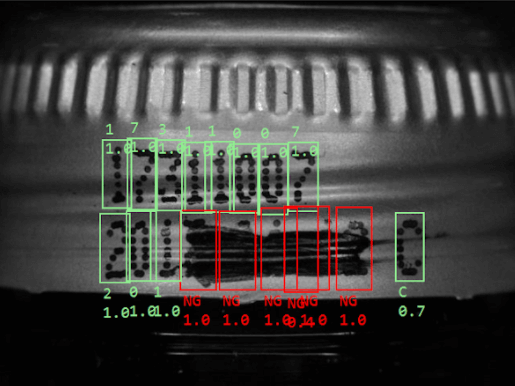
Use Case: Automated Visual Inspection of Bottle Caps for Traceability
Automated visual inspection verifies bottle cap batch numbers, expiry dates, and serial codes using AI-based OCR while logging inspection results for digital quality control.
Learn more about SolVision automated bottle cap inspection
4. Supporting Scalable Operations with Existing Workforce
As production scales, relying on manual inspection can create labor constraints and increase operational complexity. Hiring additional QC staff is not always a linear or efficient scaling strategy.
Automated visual inspection helps reduce dependency on repetitive inspection tasks, allowing teams to focus on higher-value activities.
Typical operational impacts:
- Redistribution of QC personnel to process improvement roles
- Reduced strain on staffing during peak production periods
- More consistent inspection coverage across shifts
- Better scalability without proportional headcount increases
This improves workforce efficiency while maintaining inspection consistency.
5. Supporting Proactive Quality Control Through Data
Beyond defect detection, automated visual inspection generates structured data that can be used to analyze production performance over time.
This enables a shift from reactive inspection to more proactive quality management.
Key applications include:
- Identifying recurring defect patterns in production
- Supporting root cause analysis for process variation
- Monitoring stability of equipment and production conditions
- Enabling data-driven quality improvement initiatives
Over time, this data can help manufacturers better understand process behavior and reduce recurring quality issues.
Conclusion
Automated visual inspection provides a structured and scalable approach to quality control that addresses key limitations of manual inspection. Compared to traditional QC methods, it offers:
- More consistent inspection outcomes
- Faster, real-time defect detection
- Improved digital traceability
- Greater workforce efficiency at scale
- Enhanced access to quality data for analysis
As manufacturing environments become more automated and data-driven, automated visual inspection plays a growing role in supporting stable and efficient QC processes.
Automated Visual Inspection FAQs
Is automated visual inspection suitable for industrial environments?
Yes. Automated visual inspection systems are designed for industrial use and can be deployed in manufacturing environments with varying levels of complexity.
How does automated visual inspection differ from traditional machine vision?
Traditional machine vision typically relies on predefined rules (e.g., threshold-based checks). AI-based automated visual inspection uses learned models that can adapt to more complex and variable defect patterns.
Can automated visual inspection integrate with existing factory systems?
In most cases, yes. These systems can typically integrate with PLCs, MES platforms, and other factory automation infrastructure using standard industrial communication protocols.
What types of defects can automated visual inspection detect?
Depending on the application and training data, automated visual inspection systems can detect surface defects, dimensional anomalies, assembly errors, missing components, and other visual quality issues.
Does automated visual inspection require continuous technical expertise to maintain?
No. Ongoing system tuning may be required, but many modern platforms are designed for QC teams to update and retrain models without needing specialized AI modelling technical expertise.
Request a Demo of Automated Visual Inspection
See how SolVision improves quality control on your production line