
AruCo Markers for Robot Localization: Benefits and Industrial Applications
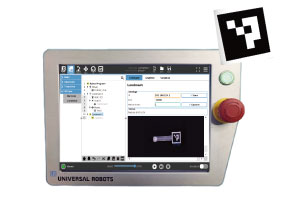
What Is Robot Localization?
Robot localization determines a robot’s position and orientation within its working environment. It is a foundational requirement for autonomous navigation, material handling, inspection, assembly, and any automated task that depends on spatial accuracy.
In industrial environments, localization performance directly affects system behavior. Errors in position estimation lead to misaligned picks, incorrect placement, inefficient motion paths, and inconsistent execution between cycles.
As automation moves toward more flexible and distributed layouts, localization must remain stable across changing operating conditions. One approach used in structured environments is AruCo marker-based localization, which provides fixed visual reference points for pose estimation.
What Are AruCo Markers?
An AruCo marker is a fiducial visual pattern used in computer vision to define a known reference point in space. Each marker encodes a unique binary ID that can be detected and decoded by a camera system.
Developed within the OpenCV framework, AruCo enables estimation of a marker’s pose—its position and orientation—relative to the camera.
Because each marker is uniquely identifiable, it can serve as a fixed spatial anchor for robot localization, alignment, and calibration tasks.

How AruCo Markers Support Robot Localization
AruCo-based localization follows a vision-driven pose estimation pipeline:
- A camera captures an image containing one or more markers
- The system detects and decodes marker IDs
- The pose of each marker is computed from image geometry
- Robot position is derived relative to marker coordinate frames
- Output is used for navigation, alignment, or task execution
This method is typically applied in structured environments where reference points can be installed at defined locations such as workstations, fixtures, or navigation zones.
It is a deterministic approach suited to controlled layouts rather than unstructured or dynamic environments.
When Are AruCo Markers Used?
AruCo markers are used when systems require reliable positioning without introducing high-complexity localization stacks.
Common scenarios include:
- AMR navigation in structured facilities
- Workstation and fixture alignment
- Robot cell calibration and setup
- Vision-guided pick-and-place operations
- Docking and charging alignment
- Equipment referencing across multiple stations
The approach is most effective when spatial structure is known and repeatable.
Industrial Applications of AruCo Markers
Manufacturing
In manufacturing environments, AruCo markers provide spatial references for repeatable robot operations across workcells.
Applications include:
- Assembly guidance
- Fixture alignment
- Part positioning
- Pick-and-place execution
- Workcell calibration
They help stabilize execution where small positional drift impacts output consistency.
Logistics and Material Handling
In logistics systems, robots rely on consistent localization to move between stations, inventory zones, and loading points.
Applications include:
- AMR navigation
- Pallet and station identification
- Docking alignment
- Transport routing
- Inventory handling workflows
Markers define fixed reference points that simplify navigation logic in structured layouts.
Quality Inspection
Inspection systems depend on consistent geometry between camera, object, and inspection target.
AruCo markers support:
- Inspection position alignment
- Camera-to-target calibration
- Repeatable inspection setup
- Multi-point inspection coordination
This reduces variability introduced by mechanical tolerances or repositioning.
Industrial Robotics and Automation Cells
AruCo markers are frequently used during system setup and calibration phases.
Applications include:
- Robot-to-camera calibration
- Tool center point verification
- Eorkcell alignment
- Multi-robot referencing
- System commissioning
They provide a reference framework for maintaining spatial consistency across deployment cycles.
Benefits of AruCo Markers for Robot Localization
Deterministic Pose Estimation
Markers provide fixed reference points that enable repeatable calculation of position and orientation in structured environments. This reduces ambiguity in spatial alignment across repeated operations.
Reduced System Complexity
AruCo-based localization can be implemented using standard industrial cameras and printed markers, avoiding the need for multi-sensor fusion stacks in controlled environments.
This reduces calibration overhead and simplifies system architecture.
Flexible Deployment Model
Markers can be added or repositioned without modifying core system logic. This allows layouts to evolve while maintaining consistent localization behavior, provided marker configurations are updated accordingly.
Compatibility with Vision Systems
AruCo is widely supported in computer vision frameworks and integrates with common robotics and automation stacks.
It can be deployed within existing workflows for navigation, calibration, or guided manipulation without requiring major infrastructure changes.
Stable Operational Behavior
Consistent pose estimation improves repeatability in motion and task execution. This is particularly relevant in applications where small positional errors accumulate into downstream deviations.
AruCo Markers in Automated Material Handling
In automated material handling systems, localization directly affects navigation accuracy, pick consistency, and system throughput.
AruCo markers provide fixed spatial anchors that define predictable reference points across operational zones. These anchors support robot movement between stations, alignment at pickup/drop-off points, and structured workflow execution.
In controlled environments, this approach enables reliable positioning without introducing complex localization infrastructure.
Summary
AruCo marker-based robot localization provides a practical method for enabling repeatable robot positioning in structured industrial environments.
It is best suited to applications where:
- Spatial layouts are defined
- Reference points can be physically deployed
- Repeatability is prioritized over adaptability
Within these constraints, it offers a low-complexity and widely adopted approach for improving positioning reliability across manufacturing, logistics, inspection, and material handling systems.