
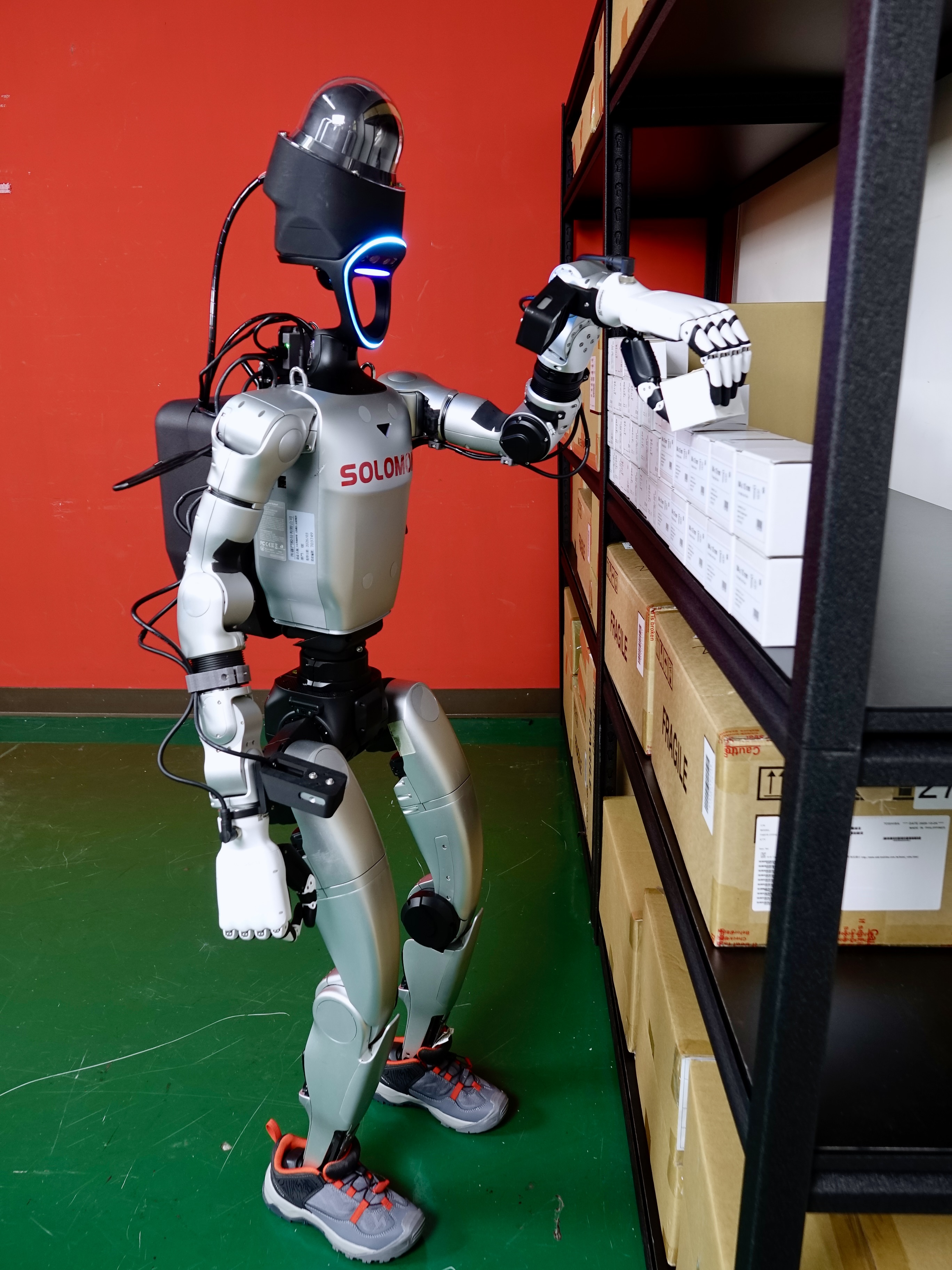
TAIPEI, Taiwan — June 02, 2026 — Solomon today announced the integration of NVIDIA NemoClaw architecture to coordinate multiple AI agents on humanoid robots, combining reasoning, perception, sensor fusion, locomotion, and manipulation into a unified workflow to further advance Physical AI and autonomous robotics applications.
Powered by NVIDIA open-source foundation models and Solomon’s proprietary Active Perception technology, the robot is capable of understanding tasks, actively adjusting viewing angles, optimizing positioning for picking and handling, and dynamically adapting to environmental changes during execution. All of these AI workflows and perception capabilities are powered at the edge by NVIDIA Jetson platforms, enabling real-time autonomous operations directly on the robot. This significantly enhances the reliability and autonomy of humanoid robots operating in complex real-world environments.
Solomon noted that today’s humanoid robots still rely heavily on short-range vision for semantic understanding, often requiring them to move close to objects in order to confirm targets or interpret environmental context. By combining Solomon’s Active Perception technology with NVIDIA open-source foundation models and AI reasoning capabilities, humanoid robots can now achieve a more advanced level of visual intelligence through a human-like understanding of environmental context, enabling near-superhuman long-range perception capabilities. This not only allows robots to approach and execute tasks more precisely, but also significantly improves operational efficiency by reducing the need to constantly move closer to objects for verification.
By combining Solomon’s Active Perception technology with NVIDIA NemoClaw, an open-source reference stack design to more safely run autonomous AI agents, a much broader range of practical humanoid robot applications is expected to become achievable in the near future. Through the flexible coordination of AI agents and perception capabilities, humanoid robots will be able to perform increasingly complex and autonomous workflows across factories, warehouses, retail environments, and public infrastructure sites. These applications may include surveillance, quality inspection, and material handling, accelerating the commercialization and real-world adoption of Physical AI technologies.