
4 Common Misconceptions About AI in Industry
Artificial intelligence (AI) is increasingly used across industrial operations, including manufacturing, logistics, warehousing, and automation, to improve efficiency, quality control, safety, and operational decision-making. Despite growing adoption, many organizations still hesitate to implement AI because of concerns around cost, complexity, workforce impact, and integration with existing systems.
In industrial environments, the discussion around AI is usually practical. Teams want to know whether a system can improve inspection consistency, reduce manual workload, integrate with existing infrastructure, and deliver reliable performance in production environments where speed and repeatability matter.
Modern industrial AI systems are increasingly being deployed to address specific operational challenges such as defect detection, traceability, process monitoring, and workflow optimization. This article examines several common misconceptions that continue to shape how organizations evaluate AI in real-world industrial applications.
What Is Industrial AI?
Industrial AI refers to the application of artificial intelligence technologies in manufacturing, logistics, warehousing, and production environments to support operational processes such as inspection, monitoring, traceability, forecasting, and process control.
Industrial AI systems typically integrate with existing infrastructure such as cameras, sensors, PLCs, MES platforms, and warehouse management systems to help organizations improve consistency, operational visibility, and production efficiency.
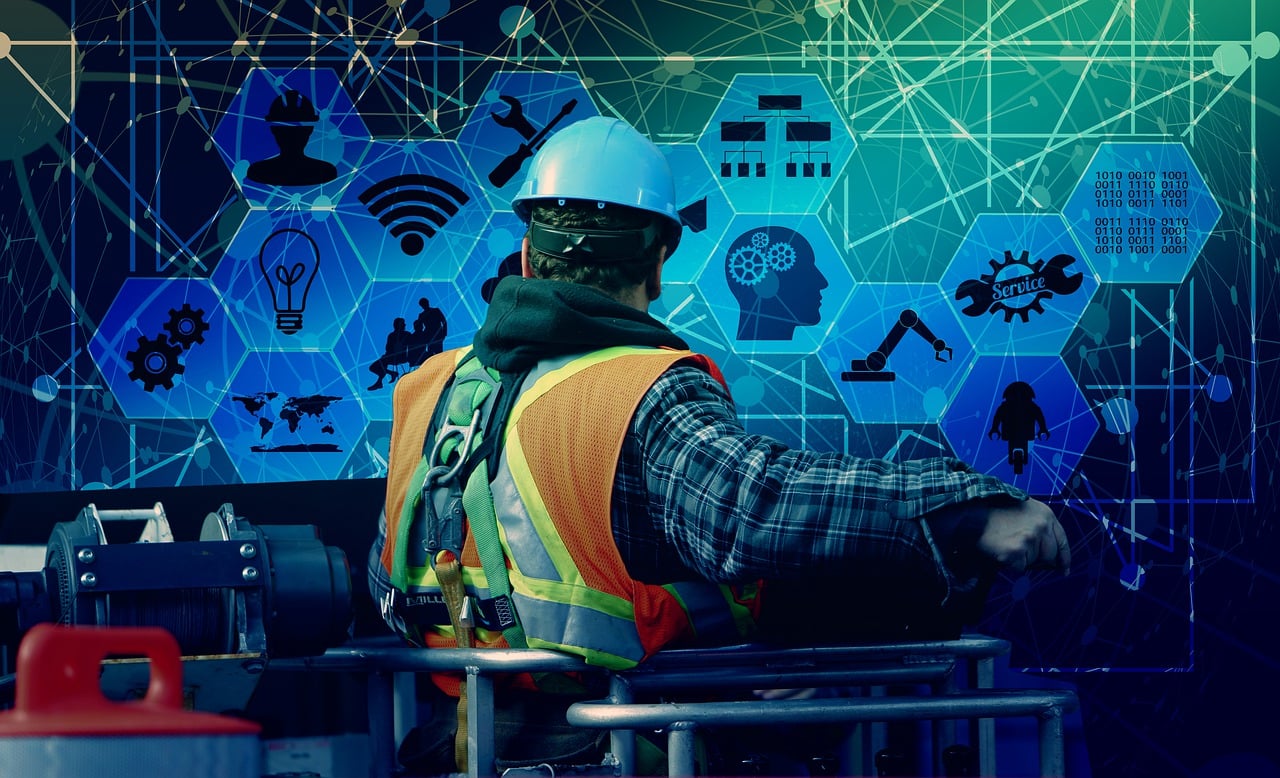
Misconception 1: AI Will Replace Workers
One of the most common misconceptions about AI is that it will replace workers entirely. In practice, industrial AI is primarily used to automate repetitive, time-consuming, or data-intensive tasks that are difficult to perform consistently at scale.
Industrial AI systems are commonly applied in:
- Automated visual inspection
- Warehouse automation
- Assembly verification
- Safety monitoring
- Defect detection
These systems help reduce manual inspection workload while allowing operators, technicians, and engineers to focus on production oversight, troubleshooting, quality management, and higher-level operational decision-making.
This is often described as augmented intelligence, or human-in-the-loop AI, where systems support operators in monitoring and decision-making within industrial workflows.
In many industrial environments, AI improves operational consistency and reduces variability in repetitive tasks. As inspection and monitoring workloads become more automated, teams can spend more time on process improvement, troubleshooting, and other higher-value operational work.
Misconception 2: AI Is Too Expensive
Industrial AI is often perceived as costly or difficult to justify financially. In practice, most organizations evaluate AI based on operational impact within a specific workflow or production challenge.
Common drivers for adoption include rising scrap rates, inconsistent inspection results, increasing rework, production bottlenecks, and traceability requirements. Industrial AI systems are frequently deployed to improve:
- Inspection consistency
- Throughput and processing speed
- Material utilization
- Predictive maintenance capabilities
- Labor efficiency
- Production visibility
Many organizations begin with a targeted application such as AI-based quality inspection or workflow monitoring before expanding deployment across additional operations.
Industries including automotive, semiconductors, logistics, pharmaceuticals, and food production already use industrial AI to improve production stability, traceability, and operational efficiency.
Misconception 3: AI Is Only for Large Enterprises
Industrial AI is no longer limited to large enterprises with dedicated data science teams or extensive infrastructure budgets. Modern industrial AI platforms are increasingly designed to scale across different operational sizes and production environments.
Small and medium-sized manufacturers often face the same operational challenges as larger facilities, including inspection variability, downtime, labor constraints, traceability requirements, and inconsistent production output.
Common SME applications include:
- AI-based quality inspection
- Inventory and warehouse monitoring
- OCR-based traceability
- Predictive maintenance
- Process optimization
Many industrial AI deployments are implemented incrementally, allowing organizations to improve specific workflows without large-scale infrastructure changes or full production redesigns.
Misconception 4: AI Is Difficult to Implement
Another common misconception is that industrial AI requires major system overhauls or advanced in-house technical expertise before deployment can begin.
Most successful implementations start with a clearly defined operational problem such as recurring defect patterns, manual inspection bottlenecks, verification steps that slow production, or limited process visibility.
Modern industrial AI platforms are typically designed to integrate with existing infrastructure and operational environments, including:
- Existing cameras and sensors
- PLC and MES systems
- Warehouse management systems (WMS)
- Production line equipment
- Existing automation workflows
Organizations often achieve better results when AI is deployed to support a specific production process rather than attempting broad operational transformation all at once.
Summary: Understanding the Practical Role of AI in Industry
Industrial AI is increasingly being applied to improve inspection consistency, production visibility, traceability, workflow efficiency, and operational stability across manufacturing and logistics environments.
As industrial operations continue adopting higher levels of automation and digitalization, AI is becoming part of day-to-day production infrastructure in environments where consistency, speed, and repeatability directly affect operational performance.
Organizations evaluating industrial AI typically see the strongest results when deployments are aligned with clearly defined operational challenges and integrated into existing production workflows.
Industrial AI FAQs
Is industrial AI worth it for manufacturing operations?
Industrial AI is typically worth implementing when recurring issues such as inspection variability, rework rates, traceability gaps, or production inefficiencies begin affecting cost, throughput, or quality consistency. Most organizations evaluate value based on measurable improvements within specific workflows rather than full-scale transformation.
What operational areas benefit most from industrial AI?
Industrial AI is most commonly deployed in quality inspection, production monitoring, warehouse operations, predictive maintenance, traceability, and workflow optimization. These applications are selected based on where consistency, speed, and real-time visibility have the greatest operational impact.
Can industrial AI be used with existing factory systems?
Yes. Most industrial AI systems are designed to integrate with existing infrastructure, including cameras, PLCs, MES platforms, warehouse management systems, and production equipment. Deployment typically focuses on enhancing existing workflows rather than replacing core systems.
What determines the success of industrial AI implementation?
Successful implementation depends on selecting a clearly defined use case, ensuring data quality and availability, and integrating AI outputs into existing operational workflows. Projects tend to perform best when scoped around specific production problems rather than broad system-wide change.