
Robotic Bin Picking with 3D Vision for Automated Pick and Place
Handling Randomly Positioned Parts with Robotic Bin Picking
Many manufacturing processes still rely on manual loading, part presentation, or dedicated fixtures because robots struggle with randomly arranged components.
Parts inside bins rarely maintain a consistent position or orientation. Components may overlap, stack together, or become partially hidden, making it difficult for robots to detect individual parts, estimate their pose, identify suitable grasp locations, and plan collision-free movements.
Robotic bin picking addresses these challenges by combining vision guidance and robot control to automate the detection, localization, and handling of randomly arranged parts without requiring fixed presentation.
Common applications include machine tending, kitting, depalletizing, material handling, and automated pick-and-place.
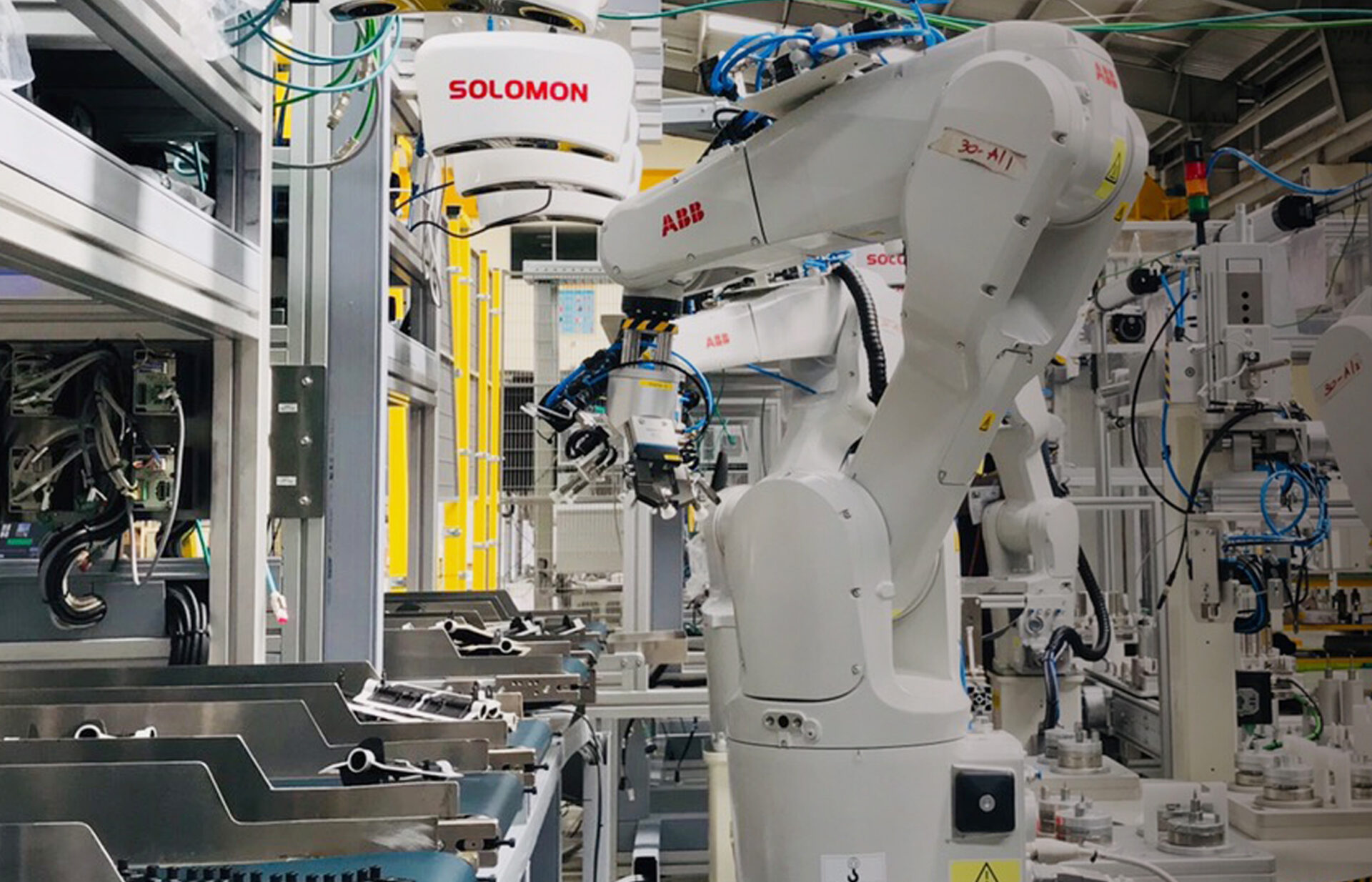
Why Robotic Bin Picking Requires 3D Vision
Random bin picking requires robots to understand the three-dimensional arrangement of objects before executing a grasp.
The system needs information about:
- Object location
- Object orientation
- Available grasp surfaces
- Depth relationships between overlapping parts
2D vision captures image information but does not directly measure object depth. This creates challenges when components overlap, stack together, or appear at different heights inside a bin.
3D vision provides depth information along the Z-axis, allowing robotic systems to estimate object position and orientation and support grasp planning.
This spatial information enables robots to operate in less structured environments where fixed part presentation is not always practical.
How Robotic Bin Picking Systems Work
A robotic bin picking system coordinates sensing, perception, planning, and robot motion to complete the picking process.
A typical workflow includes:
- 3D Data Capture: The vision system captures data from within its field of view to generate depth information.
- Object Detection and Localization: The system detects parts and estimates their position and orientation within the robot coordinate system.
- Grasp Planning: The system evaluates candidate grasp locations based on object geometry, accessibility, and collision constraints.
- Robot Execution: The robot follows planned trajectories, performs the grasp, and responds to changing conditions.
Unlike fixed automation, robotic bin picking systems can adapt to variations in part arrangement from one cycle to the next.
3D Sensing Technologies for Robotic Bin Picking
Different 3D sensing technologies are used in robotic bin picking systems depending on object characteristics, accuracy requirements, and operating conditions.
| Technology | How It Works | Advantages | Considerations |
| Stereo Vision | Calculates depth from differences between images captured by two cameras | Passive sensing, lower cost, and straightforward integration | Performance can decrease with low-texture objects, reflective surfaces, and poor lighting |
| Time-of-Flight (ToF) | Measures depth from the return time of emitted infrared light | Fast acquisition and compact hardware design | Lower resolution compared with some other 3D methods |
| Structured Light | Projects patterns onto objects and reconstructs depth from pattern deformation | High geometric accuracy | Performance can be affected by strong ambient light and reflective surfaces |
Factors Affecting Robotic Bin Picking Performance
Although 3D vision provides essential spatial information, certain object characteristics and operating conditions can affect picking performance.
Common challenges include:
- Transparent or reflective surfaces
- Thin or flat components with limited depth information
- Heavy object overlap or occlusion
- Similar parts stacked closely together
- Incomplete or noisy point cloud data
These conditions may require additional perception methods or application-specific optimization.
Enhancing Robotic Bin Picking with AI-Based Perception
3D vision provides geometric information about objects, but some picking scenarios require additional understanding of appearance and context.
AI-based perception can enhance robotic bin picking by helping systems:
- Segment objects in cluttered scenes
- Recognize partially visible components
- Improve object pose estimation
- Identify suitable grasp regions
This is particularly useful for applications involving complex geometries, mixed parts, and difficult visual conditions.
Example: Bin Picking Semi-Transparent Objects
Semi-transparent materials can make object boundaries and depth measurement more difficult for traditional vision approaches.
This example demonstrates robotic bin picking for semi-transparent objects in cluttered environments.
Learn more: Bin picking semi-transparent objects case study
Integrating Vision Guidance with Robotic Pick-and-Place
A complete robotic bin picking solution requires coordination between perception, planning, and robot motion.
The vision system provides object pose information, while the robot controller and motion planning system generate trajectories, execute the grasp, and respond to changing conditions.
Robotic bin picking systems support applications including:
AI-based bin picking platforms such as AccuPick integrate vision guidance, robot control, and picking workflows into a unified automation solution.
Example: Bin Picking Tiny Metal Components
Small metal components can be challenging to handle due to their size, reflective surfaces, and complex geometries.
This example demonstrates robotic bin picking for small metal parts requiring precise perception and grasp selection.
Learn more: Bin picking tiny metal components case study
Enabling Flexible Manufacturing with Robotic Bin Picking
Robotic bin picking provides manufacturers with a practical approach for automating material handling tasks that are difficult to standardize with fixed automation.
Key operational benefits include:
- Reduced manual preparation and dependence on dedicated fixtures
- Greater flexibility for mixed parts and variable inventories
- Improved automation of high-mix production workflows
- Reduced operator involvement in repetitive handling tasks
These capabilities enable manufacturers to automate material handling processes where part positions, orientations, and accessibility cannot be fully standardized.